What Is a Cubic Zirconia Dental Crown?
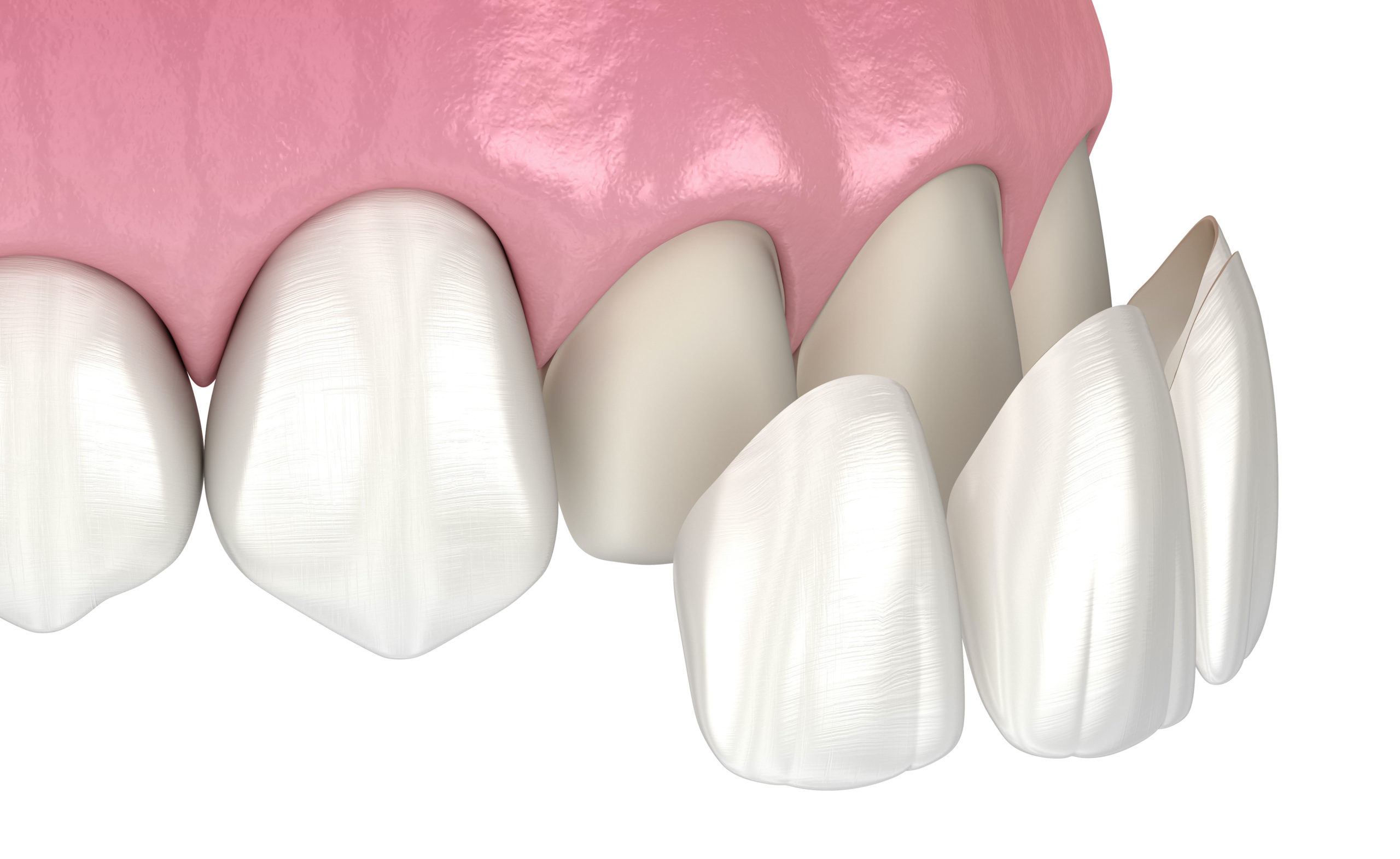
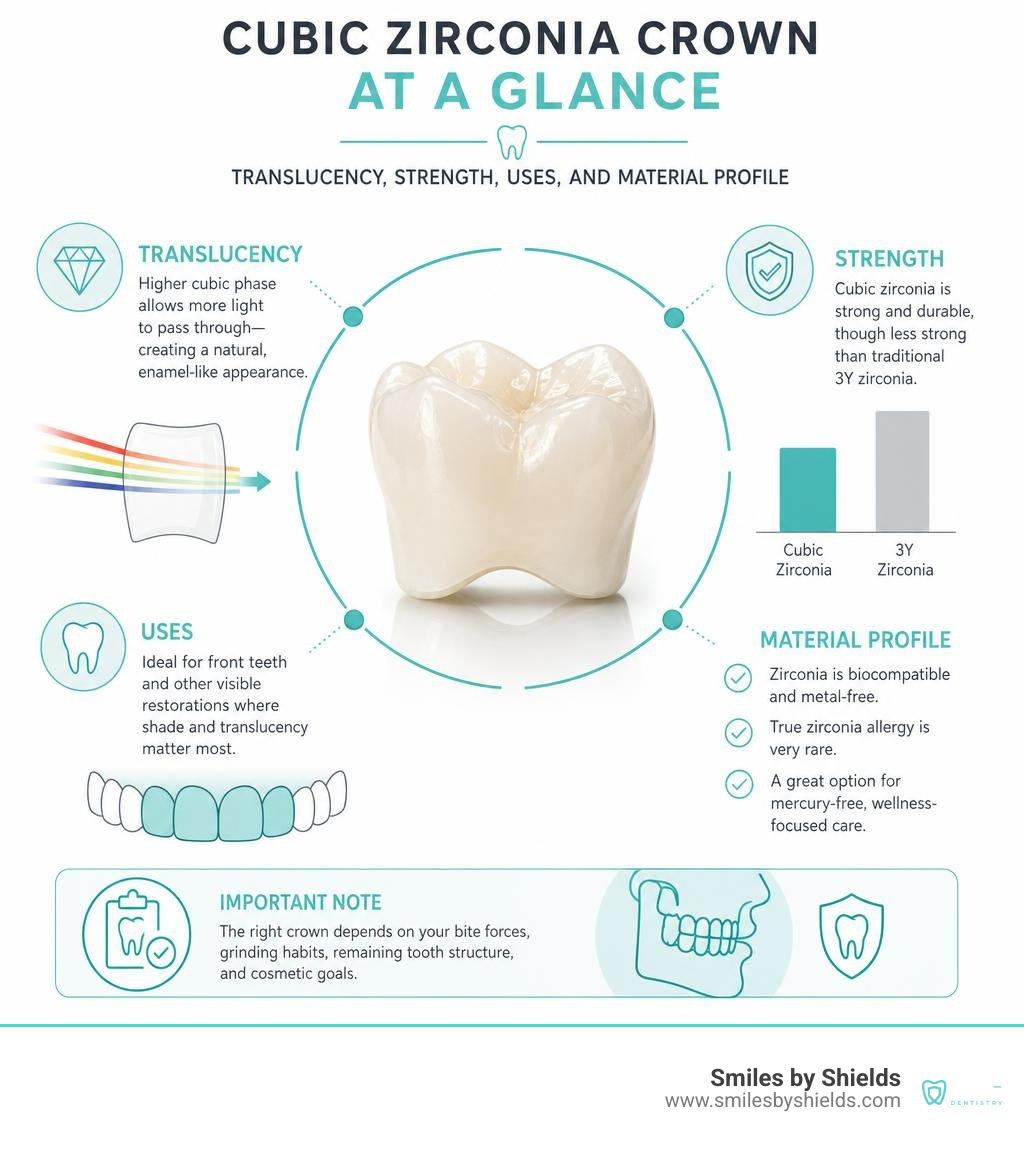
A cubic zirconia dental crown is a tooth-shaped restoration made from dental-grade zirconium dioxide with a higher cubic crystal phase. Put simply: it is a strong, metal-free crown designed to let more light pass through than traditional zirconia, helping it look more like natural enamel.
It is not the same material as a cubic zirconia gemstone. In dentistry, “cubic” usually refers to the crystal structure within modern high-translucency zirconia.
- Best known for: A more lifelike appearance in the smile zone
- Common use: Front teeth and other visible restorations where shade and translucency matter
- Main tradeoff: More cubic phase improves translucency but reduces strength compared with traditional 3Y zirconia
- Material profile: Zirconia is generally regarded as biocompatible and metal-free; true zirconia allergy is considered very rare
- Important note: The right crown depends on your bite forces, grinding habits, remaining tooth structure, and cosmetic goals
For health-focused patients, material selection can feel like more than a cosmetic choice. It is also reasonable to ask about the crown material, cement, and how each option fits into a mercury-free, wellness-centered dental plan. This guide explains what cubic zirconia means, where it fits among 3Y, 4Y, and 5Y zirconia, and when a stronger or more translucent option may make sense.
Understanding the Science of the Cubic Zirconia Dental Crown
At our holistic practice, we believe that understanding what goes into your mouth empowers you to make informed decisions for your overall health. To understand a cubic zirconia dental crown, we first have to explore zirconium dioxide (ZrO2). Derived naturally from the mineral baddeleyite, zirconium dioxide is a crystalline ceramic oxide prized in restorative dentistry for its non-toxic, bio-inert nature.
When people hear “cubic zirconia,” they often think of synthetic diamond substitutes used in jewelry. However, in modern dentistry, the term describes a specific solid-state phase configuration of zirconium dioxide. As detailed in this Cubic Zirconia Dental Crown material breakdown, introducing dynamic stabilizers like yttria allows ceramic engineers to control the internal geometry of the crystal lattice.
When you read All About Dental Crowns, you will discover that traditional dental ceramics often had to choose between extreme strength or high translucency. High-translucency cubic zirconia bridges this gap by altering how light interacts with the material at the microscopic level.
How a Cubic Zirconia Dental Crown Achieves Natural Translucency
Natural tooth enamel is optical magic. It lets ambient light penetrate below its surface, scattering it gently before reflecting back out. This quality gives teeth their depth, vitality, and natural glow.
Traditional dental zirconia consists primarily of tetragonal crystal structures. While tetragonal zirconia is immensely tough, its asymmetrical crystal shape refracts and scatters light intensely, making the crown appear bright white and opaque—sometimes likened to a chalky white chicklet.
By increasing the yttrium oxide (yttria) content during manufacturing to roughly 5 mol% (creating what is known as 5Y zirconia), the ceramic matrix stabilizes into a cubic symmetry phase.
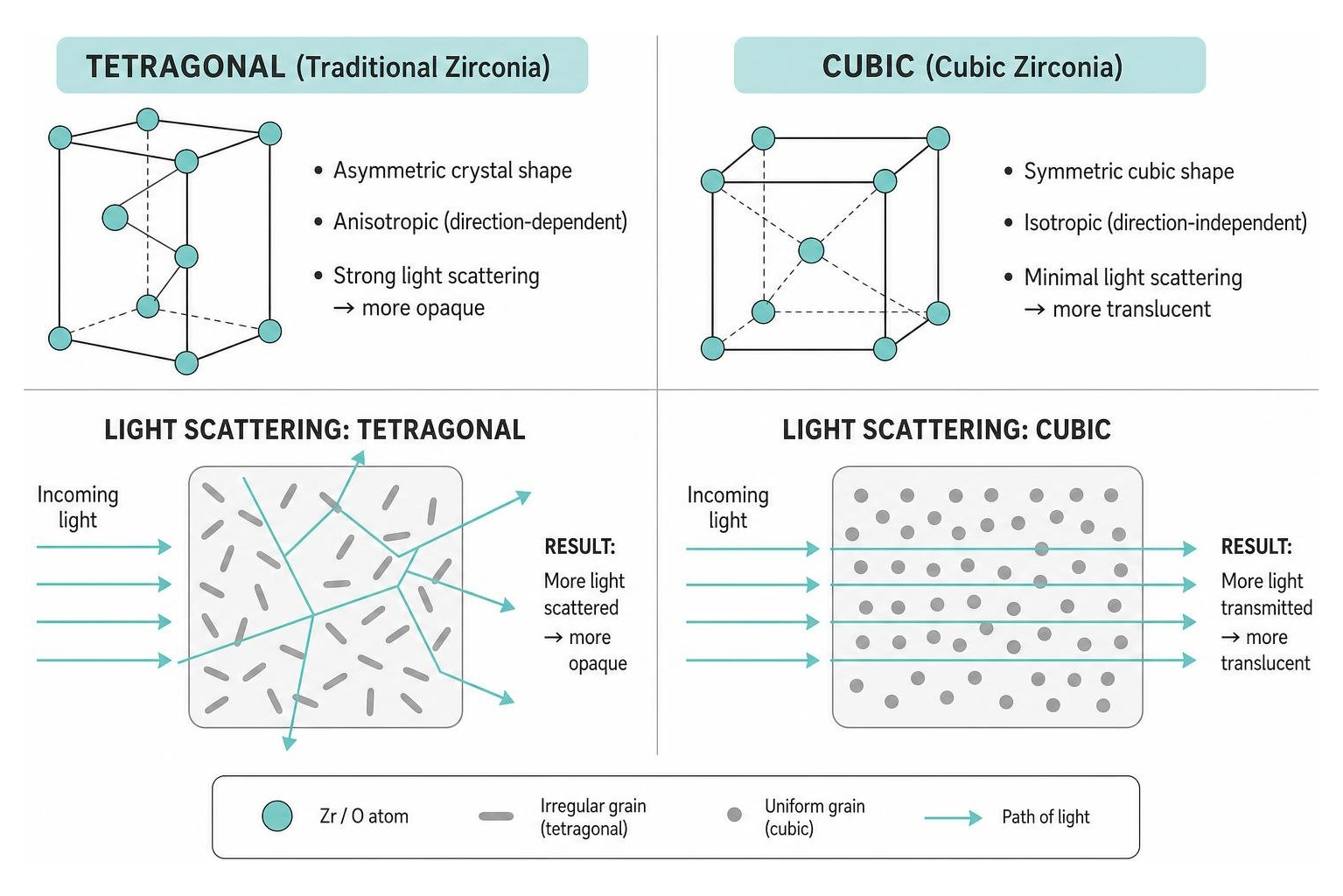
Cubic crystals are optically isotropic, meaning light travels through them uniformly in every direction rather than bouncing around at sharp angles. Because the refractive index of cubic zirconia closely matches natural human enamel, light diffuses through the crown seamlessly, achieving beautiful, natural shade matching without sacrificing structural integrity.
Dental Zirconia vs. Cubic Zirconia Gemstones
It is worth clearing up a common point of confusion: high-translucency dental cubic zirconia is not a gemstone glued to your tooth!
While both jewelry-grade cubic zirconia and dental cubic zirconia share a cubic crystal system derived from zirconium dioxide, their physical properties and intended uses are entirely different:
- Jewelry Cubic Zirconia: Formulated with high levels of yttria or calcium to create massive, single-crystal clear gems that sparkle like diamonds. They are brittle under concentrated impact and are not engineered to withstand continuous moisture or biological stresses.
- Dental-Grade Cubic Zirconia: Fabricated as dense, polycrystalline monolithic ceramics under extreme heat and pressure (sintering). They are non-porous, biocompatible, and engineered specifically to endure acidic oral environments, bacterial fluids, and relentless daily masticatory (chewing) forces.
Types of Dental Zirconia: From 3Y Tetragonal to 5Y Cubic
Not all zirconia restorations are created equal. In modern dental ceramic science, zirconia is categorized into generations based on the concentration of yttria stabilizer, which directly determines the ratio of tetragonal phase to cubic phase. As highlighted in research on Advances in Zirconia Crowns, understanding these categories helps us select the exact material tailored to your bite.
| Zirconia Generation | Yttria Content (mol %) | Phase Composition | Flexural Strength (MPa) | Optical Translucency | Primary Clinical Application |
|---|---|---|---|---|---|
| 3Y-TZP | ~3 mol% | 100% Tetragonal | 1,000 – 1,500 MPa | Low (Opaque) | Posterior molars, long-span bridges, extreme bruxers |
| 4Y-PSZ | ~4 mol% | 75% Tetragonal / 25% Cubic | 700 – 1,050 MPa | Moderate | Premolars, posterior single crowns, multi-unit bridges |
| 5Y-PSZ (Cubic) | ~5 mol% | 50% Tetragonal / 50% Cubic | 500 – 650 MPa | High (Lifelike) | Anterior incisors, canines, high-aesthetic smile line |
Mechanical Strength and Flexural Comparison
The main trade-off in ceramic physics is simple: as aesthetic translucency goes up, mechanical flexural strength goes down.
- 3Y Tetragonal Zirconia: Possesses a flexural strength between 1,000 and 1,500 Megapascals (MPa). It utilizes a biological defense mechanism known as transformational toughening. If a micro-crack begins to form under stress, the tetragonal crystals around the crack transform into a larger monoclinic phase, squeezing the crack shut and stopping it in its tracks.
- 5Y Cubic Zirconia: Delivers a flexural strength of 500 to 650 MPa. While lower than 3Y, 500+ MPa is still roughly double the flexural strength of traditional lithium disilicate ceramics (which range around 360–400 MPa) and far exceeds average human chewing forces (which average 200–400 N on individual teeth).
Microstructure and Crystal Phase Evolution
By transitioning from a 100% tetragonal phase to a 50/50 cubic-tetragonal blend, dental ceramic engineers eliminated the grain boundaries that trap and reflect light. The resulting monolithic structure features uniform cubic grain orientation. This dense, non-porous surface not only enhances translucency but also prevents plaque accumulation and soft tissue irritation along the gumline.
Advantages and Clinical Indications of High-Translucency Crowns
At Smiles by Shields, our holistic approach in Jacksonville, FL focuses on restoring your smile with materials that respect your whole-body health. High-translucency cubic zirconia crowns deliver an incredible array of clinical and holistic benefits:
- Biocompatibility & Metal-Free Safety: Zirconia is bio-inert, meaning it does not leach toxic heavy metals, corrosion byproducts, or metallic ions into your bloodstream or surrounding tissue.
- Superior Tissue Compatibility: Smooth, polished cubic zirconia surfaces discourage bacterial growth, protecting delicate gingival tissue from inflammation and recession.
- Chipping Resistance: Unlike old-fashioned porcelain-fused-to-metal (PFM) or layered porcelain crowns that frequently chip or delaminate over time, cubic zirconia crowns can be milled as a solid, monolithic single unit.
- Conservation of Tooth Structure: Thanks to its high structural strength, modern cubic zirconia allows for thinner crown wall preparations, preserving more of your natural, healthy tooth structure.
When exploring What to Know About Dental Crowns and evaluating When You Should Consider Crowns, matching the right restoration to the right location in your mouth is crucial for long-term health.
When to Choose a Cubic Zirconia Dental Crown for Anterior Teeth
The anterior aesthetic zone—your front central incisors, lateral incisors, and canines—demands maximum beauty. These teeth catch direct sunlight whenever you talk or smile.
Using a standard 3Y zirconia crown on a single front tooth can result in a flat, artificial look that stands out against neighboring natural enamel. A high-translucency 5Y cubic zirconia dental crown mimics the depth, light refraction, and subtle shade gradients of real teeth. As detailed in this High Translucent Crown preparation guide, 5Y formulations provide the optical elegance required for seamless single-tooth smile line restorations.
Posterior Indications: High Translucency vs. Traditional Strength
While high-translucency cubic zirconia is an absolute star for front teeth, posterior molars take the brunt of heavy grinding forces. For posterior teeth, we carefully evaluate your bite, habit patterns, and whether you suffer from severe nocturnal teeth grinding (bruxism).
- For Mild to Moderate Posterior Cases: Mid-translucency 4Y zirconia or 5Y cubic zirconia provides more than enough flexural strength (500–1,000 MPa) while giving back molars a natural appearance.
- For Severe Bruxism or Heavy Load Molars: Traditional 3Y tetragonal zirconia or layered 4Y multi-layer options remain the gold standard for unbreakable strength.
Here is a quick overview of primary clinical indications for high-translucency cubic zirconia crowns:
- Single-unit anterior crowns (central and lateral incisors)
- Visible premolars within the smile line
- Patients seeking a metal-free, non-toxic alternative to PFM crowns
- Aesthetic restorations where neighboring natural teeth have high natural translucency
- Patients with discolored or endodontically treated front teeth requiring high maskability paired with lifelike optical depth
The Clinical Process: Preparation, Bonding, and Long-Term Care
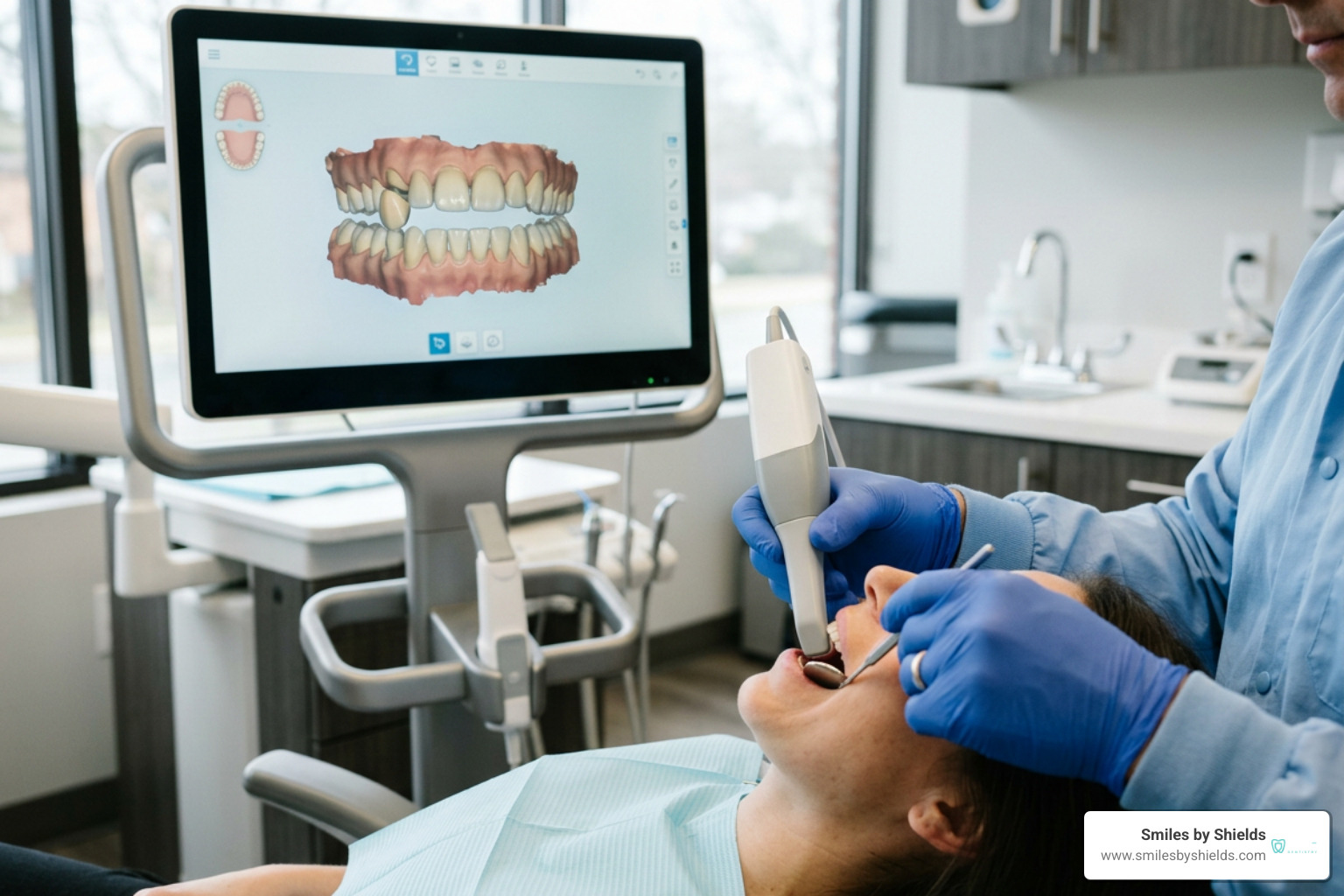
Getting a cubic zirconia dental crown is a precise, artfully executed clinical process. Recent studies on Emerging trends in zirconia crowns emphasize that precision tooth preparation combined with careful adhesive bonding forms the backbone of a successful, long-lasting restoration.
Tooth Preparation and Occlusal Reduction
To ensure your high-translucency crown withstands daily function without fracturing, appropriate tooth reduction parameters must be maintained:
- Occlusal/Incisal Reduction: 1.0 mm to 1.5 mm of space is created on the biting surface to allow sufficient material thickness for natural light diffusion.
- Axial Reduction: 1.0 mm to 1.2 mm circumferential reduction ensures vertical stability.
- Margin Design: A clear, continuous chamfer or light shoulder margin (~0.5 mm wide) is prepared at or slightly above the gumline.
- Line Angles: All sharp internal angles are smoothed and rounded to eliminate internal stress points.
Once prepared, digital intraoral optical scanners capture a 3D digital model of your tooth, eliminating the need for messy traditional impression trays. This digital file is sent to a CAD/CAM precision milling system to carve your custom crown from a solid multi-layered zirconia block.
MDP Bonding and Cementation Protocol
The chemical bond between your natural tooth and a cubic zirconia crown requires precise isolation and handling. Saliva and blood contain phosphate ions that can contaminate the internal surface of a crown during trial fittings, reducing final bond strength by up to 50%.
To guarantee a long-lasting, airtight seal, we follow a rigorous decontamination and bonding protocol:
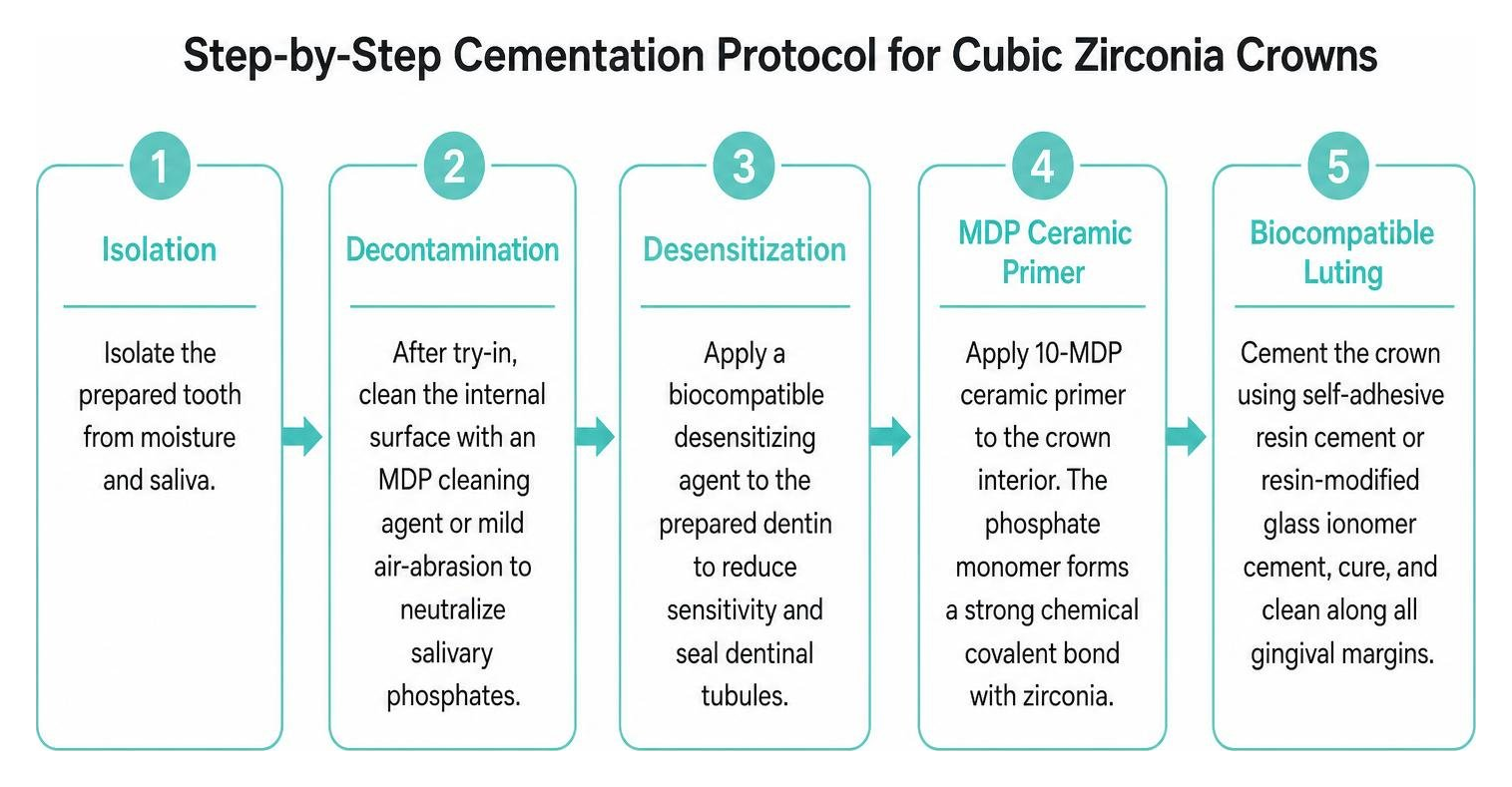
- Isolation: The prepared tooth is isolated from moisture and saliva using gentle isolation systems.
- Decontamination: After try-in, the inside of the crown is cleaned with an MDP-compatible cleaning agent or mild air abrasion to remove salivary phosphates.
- Ozone Sterilization and Desensitization: Before cementing, ozone is applied to the prepared tooth to help sterilize the surface, reduce bacteria, and desensitize exposed dentin.
- MDP Ceramic Primer: 10-MDP ceramic primer is applied to the crown interior so the phosphate monomer can chemically bond with the zirconium oxide surface.
- Biocompatible Luting: The crown is cemented with self-adhesive resin cement or resin-modified glass ionomer cement, cured, and carefully cleaned along the gumline.
Lifespan, Cost, and Maintenance
According to clinical studies, zirconia crowns demonstrate impressive survival rates between 85% and 95% over 5 to 10 years, with many well-maintained crowns easily lasting 15 to 20 years or more. Understanding the Lifespan of Dental Crowns helps put your investment into perspective.
High-translucency zirconia crowns are planned around your tooth’s condition, bite, smile goals, and long-term function. If a crown is medically necessary to repair a decayed, broken, or weakened tooth, dental insurance may cover part of the procedure.
Proper maintenance is straightforward. By following guidelines for The Art of Crown and Bridge Maintenance, you can protect your investment for decades:
- Brush twice daily with a non-abrasive toothpaste and soft-bristled toothbrush.
- Floss daily around the crown margins to maintain healthy gum tissue.
- Schedule regular holistic cleanings and examinations.
- Avoid using your teeth as tools to crack nuts, open packages, or bite ice cubes.
- Wear a custom nightguard if you suffer from heavy night-time teeth grinding.
Frequently Asked Questions About Cubic Zirconia Crowns
Do cubic zirconia crowns wear down opposing natural teeth?
A common myth is that because zirconia is extremely strong, it acts like sandpaper against opposing natural enamel. Research shows that polished monolithic cubic zirconia causes significantly less abrasive wear on opposing natural teeth than traditional feldspathic porcelain or unpolished ceramics. The key is micro-smooth surface polishing. When properly finished, glazed, and polished by your dentist, cubic zirconia glides smoothly against natural tooth enamel during chewing.
Your dentist will recommend a crown material based on the tooth’s location, bite pressure, esthetic goals, and how much healthy tooth structure remains. For zirconia crowns, proper preparation, precise fit, and a well-balanced bite all matter. With regular checkups and good home care, they can be a durable, natural-looking restorative choice.
Can patients be allergic to cubic zirconia crowns?
True allergic reactions to zirconium dioxide are exceptionally rare. Zirconia is biologically inert, non-corrosive, and far less likely to trigger sensitivities than base metal alloys like nickel or chromium. Still, for highly sensitive patients, holistic dental practices may recommend biocompatibility testing before placement to help rule out potential immune reactions to the crown material, ceramic, or cement.
Conclusion: Restore Your Smile with Holistic Restorative Care
A cubic zirconia dental crown offers a remarkable blend of modern materials science and aesthetic elegance. By increasing the cubic crystal phase within biocompatible zirconium dioxide, modern dentistry has created a metal-free restoration that mimics the natural light diffusion of human enamel without sacrificing functional durability.
At Smiles by Shields in Jacksonville, FL, our passion is helping you achieve a healthy, vibrant smile using non-toxic, biocompatible restorative solutions. Whether you need to restore a front tooth in your smile line or repair damaged teeth with wellness-focused care, our integrative team is here to guide you every step of the way.
Ready to discover how advanced, metal-free crown technology can transform your health and confidence? Explore Holistic Crown Solutions or contact our team today to schedule your personal consultation!